Most organizations can point to an AI win. Copilot saves someone half an hour. ChatGPT gets an email out faster. The gains are real, but every company has access to the same tools. They won’t set one business apart from another for long.
The more difficult work is applying AI to the parts of the business where context matters and mistakes have a cost. That requires a different kind of team.
Tools and training aren’t enough
Giving people access to a tool, running a training session, and sending them back to their usual work rarely produces much beyond personal productivity. A central AI team can help people build something more useful, but it cannot embed itself in every part of the organization.
That leaves a choice about where to spend time. Personal productivity tools help people become comfortable with AI and learn where not to trust it. Work on business processes can create an advantage that competitors cannot buy with the same software license. Both are useful, but they need different levels of support.
The work people still own
AI can produce code and documentation. It cannot decide which problem is worth solving or what a good result looks like for a particular business.
Those decisions depend on context: why a process works the way it does, what has already been tried, which trade-offs are acceptable, and what regulation allows. Much of that knowledge is held by people rather than written down in a form a model can use.
Someone also has to verify the result. Producing an answer quickly is not useful if nobody on the team can tell whether it is right.
Handoffs lose context
A common response is to ask technical teams to learn enough about the business to build a solution. They may produce something technically sound while missing the detail that matters in practice.
The reverse has its own limits. Domain experts can learn to use AI tools and prototype an idea, but that does not give them the engineering experience needed to make it reliable, secure, and maintainable.
Passing work between the two groups does not solve this. Each handoff strips away some of the reasoning behind the decisions.
Put both disciplines in the team
The better arrangement is a team where engineers and domain experts work together from the start. This does not mean everyone has to become both. It means the people who understand the systems and the people who understand the work share the problem, the decisions, and the responsibility for checking the result.
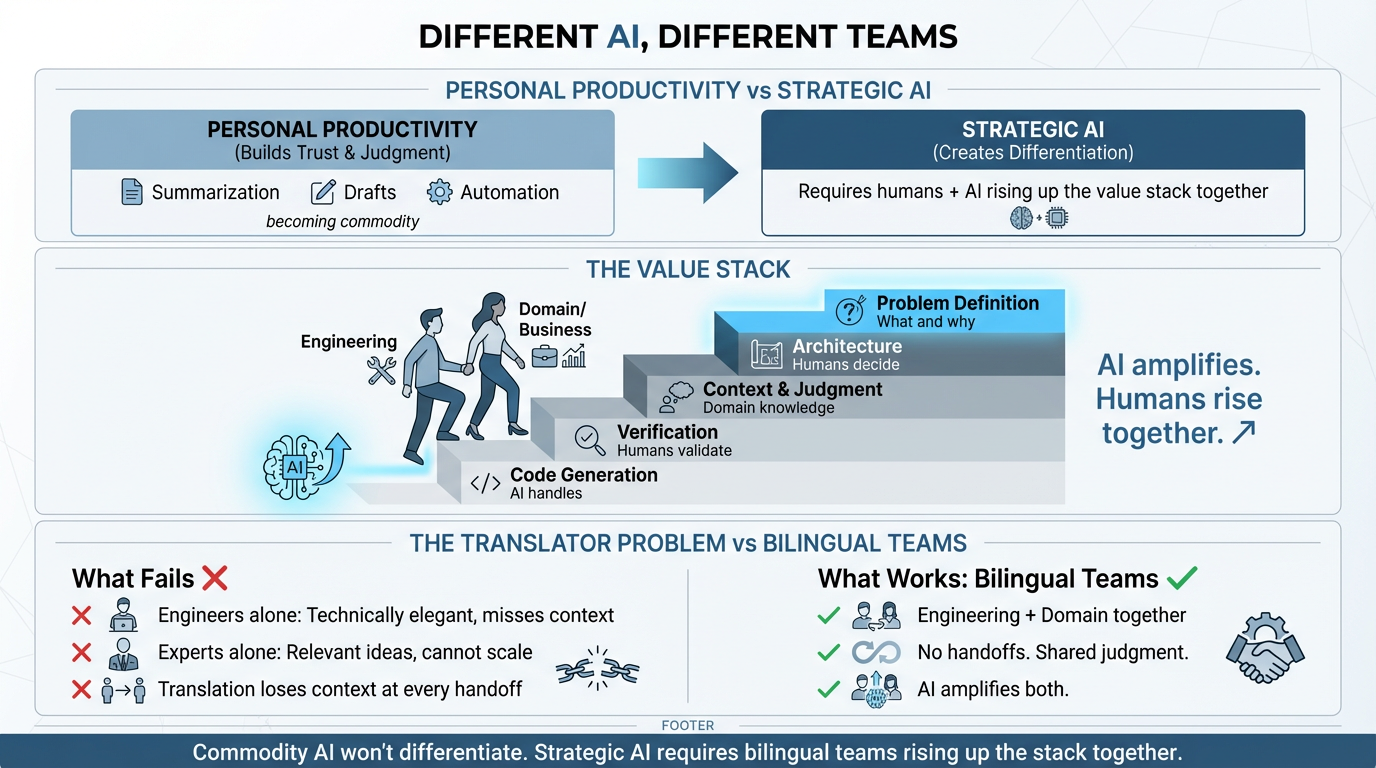
AI gives that team more leverage, but it does not replace either kind of judgment.
Before starting
I would ask four things:
- Does someone on the team know how to verify the output?
- What business context will the system need?
- What happens when it is wrong?
- Are the technical and domain experts working together, or passing work between separate teams?
If the answer to the last question is still “separate teams,” adding another AI tool will not fix the problem.